
The pH Value of Water
Did you know that the pH value plays a major role in our daily lives?
In this article, you will learn what the pH value is and how it influences our daily lives and our environment.
The most important points at a glance:
The pH value indicates how acidic or basic a solution is.
The pH scale ranges from 0 to 14.
Tap water usually has a pH value of about 7 and is therefore considered neutral.
Inhaltsverzeichnis
What is the pH value and what does it indicate?
The pH value provides information on whether an aqueous solution is acidic, neutral, or alkaline. Values below 7 indicate acidity, while values above 7 are basic. The pH value is based on the ratio of hydrogen ions to hydroxide ions in the liquid. In scientific circles, the pH value is defined as the negative decimal logarithm of the activity of hydrogen ions. Sometimes the pH value is confused with water hardness (dH), but these are different values. Water hardness measures the content of dissolved minerals such as calcium and magnesium.
What does the abbreviation pH stand for?
The abbreviation „pH“ is derived from Latin and stands for „potentia hydrogenii“ (Latin potentia = power, hydrogenium = hydrogen).
The pH Value Scale
The pH value is specified using a scale ranging from 0 (very acidic) to 14 (very basic/alkaline).

Within the pH scale, three different ranges are distinguished: liquids with a pH value of 0 to 6.9 are considered acidic. A pH value of 7 is considered neutral. pH values from 7.1 to 14 are considered basic or alkaline. The more hydrogen ions and the fewer hydroxide ions present in a solution, the lower the pH value and the more acidic the solution. Substances with pH values below 7 are referred to as acids. The fewer hydrogen ions and the more hydroxide ions a solution contains, the higher the pH value and the more basic or alkaline it is. The terms „basic“ and „alkaline“ mean the same thing and can be used synonymously. Solutions with a pH value above 7 are also referred to as bases or alkalis. You can remember it this way:
- More hydrogen ions and fewer hydroxide ions lead to a lower pH value.
- Fewer hydrogen ions and more hydroxide ions lead to a higher pH value.
The pH value of a liquid is often displayed using a color scale. This applies, for example, to test strips with an indicator dye: the pH indicator changes its color to orange-red in acidic solutions and to green-blue in basic solutions. You can find more on this topic in the section „Measuring the pH value.“
Where is the pH value important in everyday life?
Acids and bases are part of your life every day. Sometimes unnoticed in the background, sometimes quite obviously. We will show you examples of where and how acids and bases play a role in our daily lives.
Soils
The pH value of the soil significantly influences the growth and nutrient uptake of plants. Most plants and organisms in the soil thrive best with a balanced ratio of acid and base, which corresponds to pH values of about 6.5 to 7.5. However, there are also plants, such as rhododendron and rowan, that prefer acidic soils with a pH value between 4.5 and 6.
Food
The pH value is crucial for food production and affects both taste and shelf life. Milk, for example, has a pH value between 6.6 and 6.8. As soon as the pH value drops to 4.7, the coagulation process begins. In cheese production, the pH value influences the texture, taste, and color of the cheese. Bread dough, for example, requires a low pH value, as this is the only way CO2 can be produced and the dough can rise properly. In beer brewing, the pH value is of decisive importance in every phase of the process: from the brewing water (pH value below 6) to the mash (pH value of 5.2 to 5.6), the wort (pH value of 5.2 to 5.6), and the yeast (pH value of 4.0 to 4.5) to the finished beer (pH value of 4.1 to 4.6).
Body
The pH value is an essential factor for the human body. The pH value of blood lies in the basic range between 7.38 and 7.42. Within this spectrum, tissues and most cells function best. If the pH value is outside this normal range, it can cause health problems. A blood pH value below 7.38 is medically referred to as acidosis. Symptoms can include chronic fatigue or lethargy. Joint pain, muscle tension, and headaches can also occur. An elevated pH value of over 7.42 can also cause health problems such as dizziness and muscle cramps. This is medically referred to as alkalosis. In contrast, human skin has a slightly acidic pH value of 5.5 to protect itself from pathogens. Have you ever wondered why soaps are labeled „pH-neutral“? „pH neutral“ does not refer to the pH value of the soap itself, but to the preservation of the skin’s pH value. So-called pH-neutral soaps are slightly acidic and thus contribute to maintaining the acidic pH value of human skin. One organ of our body that requires a particularly acidic environment is the stomach. Gastric acid has a pH value of 1.2 to 3, which is crucial for the digestion of food. Good to know: Foods that taste sour do not necessarily have an acidic pH value. For example, lemons are metabolized as basic, while dairy products are considered acidic. Your body constantly strives to keep the acid-base balance stable within normal values.
pH Value Table
Here is an overview of the pH values of various liquids, ranging from very acidic to strongly basic.
| LIQUID | PH VALUE | |
|---|---|---|
| Hydrochloric acid 3.6% | 0 | |
| Hydrochloric acid | 1.0 | |
| Gastric acid | 1.2 – 3 | |
| Citric acid | 2 | |
| Acetic acid | 2.5 | |
| Cola | 3 | |
| Orange juice | 3.5 | |
| Wine | 4 | |
| Beer | 4.6 | |
| Coffee | 5 | |
| Tea | 5.5 | |
| Milk | 6.5 | |
| Pure water | 7 | |
| Blood | 7.38 – 7.42 | |
| Soap | 9.5 | |
| Detergent | 10 | |
| Bleach | 12.5 | |
| Drain cleaner | 13 | |
| Sodium hydroxide | 14 |
pH Value of Water
In water, too, the pH value influences many chemical and biological processes. For example, it changes the taste of the water or the disinfecting effectiveness of chlorine in pools. Extreme pH values can have extremely corrosive effects: acidic water with a pH value below 6.0 promotes the formation of carbonic acid from bicarbonates, which can damage concrete and lead to the corrosion of steel. Pure water has a neutral pH value of 7. In everyday life, however, we normally encounter water that has been exposed to the elements or has undergone various processes. Take, for example, the water from the Perlbachtalsperre, located near Aachen in North Rhine-Westphalia. The raw water from the Perlbachtalsperre has a slightly acidic pH value of 6.5. After treatment in the waterworks, the pH value of the water is 8.5 and is therefore basic. The pH values of different types of water vary considerably in some cases. Here we present the most important types of water and their pH values.
pH value of distilled water
Distilled water generally has a pH value of about 7, which is neutral. However, this pH value is extremely unstable because as soon as distilled water comes into contact with the ambient air, it reacts with carbon dioxide to form natural carbonic acid, causing the pH value to drop to about 5.
pH value of rainwater
The recommended pH value for untreated rainwater is 5.6. However, no general statement can be made about the pH value of rainwater. This varies depending on the region due to so-called acid formers in the atmosphere. Therefore, the pH value of rainwater in different areas can range between 5.5 and 5.8. Due to air pollution, more nitrogen oxides and sulfur oxides enter the atmosphere, leading to a significant reduction in the pH value of rainwater. Rainwater with a pH value below 5.5 is referred to as „acid rain“ (acid rain). As soon as this acidic rainwater falls to the ground, it influences the natural pH values of soils and bodies of water, thereby damaging the entire biosphere. In the 1970s, acid rain led to massive forest dieback and the acidification of waters and soils. Even today, the effects of acid rain on the ecosystem are still palpable.
pH value of groundwater
Unpolluted groundwater has a pH value in the range of 6 to 8.5. The pH value of groundwater can vary depending on the region. For example, the pH value of groundwater originating from carbonate-rich rocks is higher than that of groundwater from carbonate-poor rocks such as sandstone.
pH value of tap water
In Germany, the Drinking Water Ordinance sets a pH value for drinking water between 6.5 and 9.5. Usually, however, it lies between 7.0 and 8.5, depending on regional factors. Tap water in Cologne and Berlin, for example, has an average pH value of 7.4 and is therefore almost neutral. In Munich, the average pH value of tap water is 7.6, which is slightly basic. In Dresden, tap water has the highest basic pH value compared to other cities, with an average of 7.9.
pH value of mineral water
Mineral water typically has a pH value between 5.5 and 6.7, depending on its mineralization and carbon dioxide content, placing it in the slightly acidic to neutral range.
pH value in aquariums
Fish are extremely sensitive to the pH value of the water. Some aquatic plants and fish species can only survive in an acidic environment with pH values around 6, while others require neutral (pH 7) or alkaline water (pH 8). For aquarium owners, it is therefore important to check the pH value of the water regularly and adapt it to the needs of the fish and plants.
pH value in pools
The ideal pH value for swimming pools is between 7 and 7.4. Both too low and too high pH values in the pool can be harmful. Therefore, it is advisable to check and adjust the pH value in the pool regularly. You will learn what difficulties high or low pH values in the pool can cause and how you can increase or decrease the pH value in the pool in the following section: Changing the pH value in water
pH value of seawater
The average pH value of seawater is 8.1 to 8.2 and is therefore alkaline. Note: Oceans are capable of storing large amounts of carbon dioxide, which leads to an increasing decrease in the pH value of the oceans! In the last 200 years, the oceans have stored more than a quarter of all human-induced atmospheric carbon dioxide. Without this ocean storage, global warming would likely be even further advanced at this point. However, the storage function comes at a price: since the beginning of the industrial age, the oceans have become nearly 30 percent more acidic.
pH Value Table for Water
| TYPE OF WATER | PH VALUE | |
|---|---|---|
| Rainwater | 5.5 – 5.8 | |
| Groundwater | 6 – 8.5 | |
| Distilled water (without contact with the environment) | 7 | |
| Mineral water | 5.5 – 6.7 | |
| Tap water (according to Drinking Water Ord.) | 6.5 – 9.5 | |
| Water in aquariums | Depending on fish/plant species | |
| Water in swimming pools | 6.7 – 7.5 | |
| Seawater | 8.1 – 8.2 |
How can the pH value in water be determined?
There are various methods to determine the pH value of your water. Potentiometric methods use pH-sensitive electrodes to detect electrical voltage. This method is characterized by high accuracy and is frequently used in laboratories and industry. Alternatively, optical methods exist that are based on color changes and are easier to use. Would you like to measure the pH value of tap water or the water in your pool yourself? For home use, the so-called litmus test is suitable: a visual method for determining the pH value in water using color indicators. 
Measuring the pH value with the litmus test
Litmus is a dye obtained from a certain type of lichen. In chemistry, it is used as an „indicator“ or „indicator dye“ for acids and bases. A special property of this dye is that it changes its color depending on whether it comes into contact with acidic or basic liquids. With the litmus test, the pH value in water can be determined very easily: you only need a pH test kit that contains a small test strip and a comparison chart. Simply dip this test strip into the water. Then take the test strip out of the water and observe how it changes color. At an acidic pH value, the test strip turns reddish; at basic pH values, it takes on a bluish color; and in the neutral range, it appears violet. Finally, you can assign the color of the test strip to a pH value using the comparison chart. Please refer to the operating instructions for your test kit for exactly how to perform the test. Of course, a pH measurement with indicator dyes is less accurate than professional laboratory measurements with electrodes. Nevertheless, you can easily determine the pH value of liquids yourself. Another important note: water temperature influences the measurement! If you take a sample of water at 25 degrees, the pH value may differ compared to a measurement of the same water at 50 degrees. In general, the pH value of basic solutions decreases with increasing temperature. An example: you take a water sample with a water temperature of 0 degrees and find a pH value of, for example, 7.4. Then you take a sample of the same water, which is now 25 degrees Celsius. You measure a pH value of, for example, 7. In the meantime, the water has reached a temperature of 50 degrees, and a new pH measurement yields, for example, a pH value of 6.6. This example is fictional. However, it conveys an impression of the temperature-dependent change in pH measurements. However, temperature has a lesser influence on the pH value of acidic solutions. The ideal water temperature for pH measurement is 25 degrees, as the neutral point of pure water is exactly 7 at this temperature.
How can you adjust the pH value of water?
The pH value of tap water is thoroughly monitored by local waterworks. Usually, you do not need to check or adjust the pH value of tap water for consumption. If you have an aquarium or a pool at home, you should check the pH value of the water regularly and adjust it if necessary.
The correct pH value in the aquarium
Find out which pH value the fish and plant species in your aquarium require.
How can the pH value in the aquarium be reduced?
You can reduce the pH value in the aquarium naturally with materials such as soil, peat, or alder cones. However, water treatment agents that reduce the pH value in the water, for example through natural acids, are more effective.
How can you increase the pH value in the aquarium?
To increase the pH value in the aquarium, you can, for example, increase the movement of the water surface. Attach the outlet pipe just below the water surface. This ensures that the water surface moves more intensely, thereby reducing the CO2 concentration in the water and increasing the pH value. If you cannot increase the pH value sufficiently with this method, water conditioners can also help in this case. You can find these in specialist shops, online, and in some hardware stores.
The optimal pH value in the swimming pool and hot tub
The ideal pH value for swimming pools and hot tubs is in the neutral to slightly basic range of 7 to 7.4. The pH value of pool water can be influenced by rain, impurities, or foreign substances. You should check the water in the pool regularly, as both too high and too low pH values can harm health and the material of the pool. 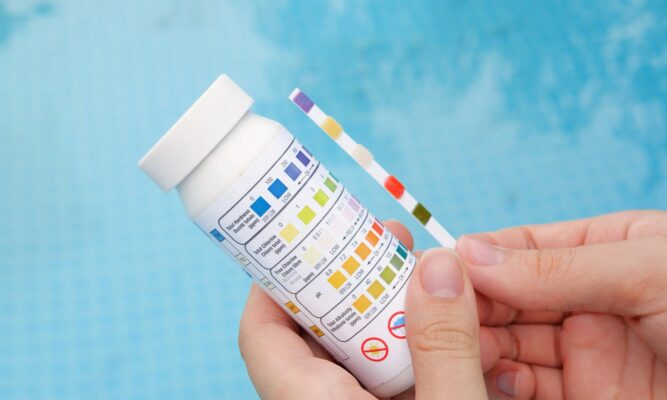
How can you lower the pH value in the pool?
Your pH measurement has shown that the pH value in the pool is too high. Then the water tends to form lime deposits and the disinfecting effect of chlorine decreases. You can lower the pH value in the pool by using pH reducers.
How can you increase the pH value in the swimming pool?
Is a pH value that is too low in the pool also harmful? Yes, a pH value that is too low in the pool can be problematic! For the skin, a pH value of 5.5 would be ideal. However, such acidic water would irritate the eyes and mucous membranes and damage metallic components in the pool. To increase the pH value in the pool, you can use pH increasers.
Conclusion: The quality of water is significantly dependent on the pH value.
The entire ecosystem, our health, many everyday products, and also water quality are crucially dependent on the pH value. The pH value of tap water is carefully monitored and adjusted by the waterworks. However, there are other factors that influence water quality and cannot be fully captured by waterworks: some concerning pollutants, such as drug residues, cannot be completely filtered out of the water in sewage treatment plants. No limit values have been set for these substances yet, which means that drinking water is considered pure even if it may contain residues of medications, for example. Such pollutants clearly have no place in drinking water. Another source of contamination in water is the domestic pipes, which are no longer subject to controls. While water supply companies adjust the pH value of drinking water, riva water filters reliably protect against pollutants in the water. Our riva water filters thus ensure clean drinking water in the household, outdoors, and in the motorhome. We are also happy to assist you personally. You can simply contact us at the following number: 07424 9014018.
FAQs: pH Value of Water
What pH value in water is healthy?
According to the Drinking Water Ordinance, a pH value of 6.5 to 9 is suitable for drinking water. For water in swimming pools, however, an optimal pH value is between 7 and 7.4.
What does the pH value measure?
The pH value indicates the concentration of hydrogen ions and shows whether a solution is acidic or basic. A low pH value indicates acidity, while a high pH value indicates alkalinity.
Is tap water basic or acidic?
Tap water has an average pH value of 7 to 8.5 and is therefore slightly alkaline.
What pH value should water for drinking have?
The German Drinking Water Ordinance recommends a pH value between 6.5 and 9 for drinking water. Water providers ensure that the pH value of tap water is on average 7 to 8.5.
Is tap water pH neutral?
The pH value of tap water varies depending on the region. On average, the pH value of tap water is between 7 and 8.5, which is in the slightly basic range.
What pH values are there?
There is a pH scale from 0 to 14. Liquids with a pH value of up to 6.9 are considered acids. A pH value of 7 is neutral. At a pH value of 7.1 and higher, one speaks of bases.
Why does water have a pH value of 7?
The pH value of water is related to the concentration of hydrogen ions and hydroxide ions. Water with a pH value of 7 has a balance between hydrogen ions and hydroxide ions.
What is alkaline water?
Water with a pH value of 7.1 to 14 is considered alkaline water. In alkaline water, there are more hydroxide ions than hydrogen ions.
What is acidic water?
Water with a pH value of 0 to 6.9 is considered acidic water. In acidic water, there are more hydrogen ions than hydroxide ions.
What does pH neutral mean?
pH-neutral means that the pH value of a solution is exactly 7. It is neither acidic nor basic, but balanced and located in the neutral range of the pH scale.
Is dH the same as pH?
No, the pH value records the acid or base content of a solution, while the degree of hardness (dH) describes the content of dissolved minerals such as calcium and magnesium in the water. These are two different measurement parameters.
- Müller-Plathe, O. (2019). pH value in blood. In: Gressner, A.M., Arndt, T. (Eds.) Lexicon of Medical Laboratory Diagnostics. Springer Reference Medicine. Springer, Berlin, Heidelberg.
- Sachsen.de: pH values in precipitation
- Foodspring: Alkaline water
- Studyflix: pH value
- Studyflix: Acid rain
- Lower Saxony State Office for Water Management, Coastal Protection and Nature Conservation. Groundwater Report Lower Saxony, pH value
- Deutschlandfunk: Environment – The long-lasting effects of acid rain
- Dr. Gumpert: Distilled water
- Leibniz Institute of Freshwater Ecology and Inland Fisheries: Acid rain was yesterday
- NDR: How healthy is mineral water?
- RheinEnergie: Water investigation Cologne right bank of the Rhine 2020
- Stadtwerke München: Drinking water analysis values
- Chemie Fonds: Chemical Index
- Federal Ministry of Agriculture, Regions and Tourism: Chemical and physical terms for water quality.
- Zentrum der Gesundheit: pH value
- Wasserwerk Perlenbach: Hardness determination and pH value
- Alfred Wegener Institute: Facts on ocean acidification
- Xylem Analytics: pH Primer
- Hanna Instruments: The importance of the pH value in the brewing process of beer
- Berliner Wasserbetriebe: pH value
- Umweltbundesamt: Pool Project